When Every Angle Is Available, Where Do You Begin? The Quiet Paralysis of Infinite Perspective
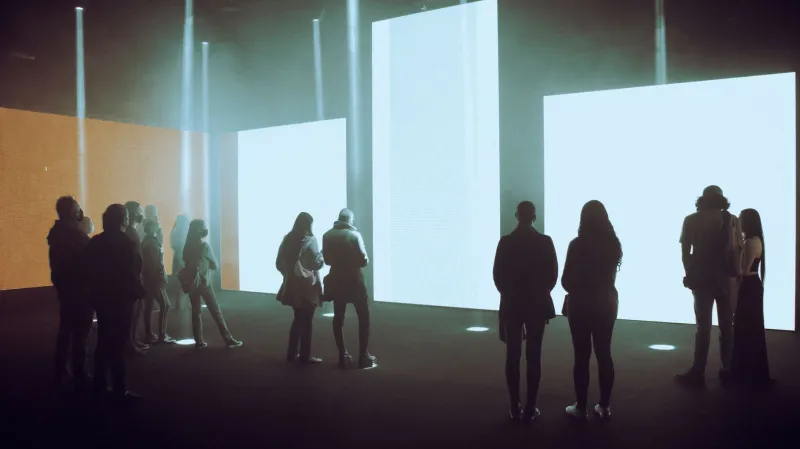
There is a particular kind of stillness that settles over visitors inside the most technologically ambitious gallery spaces in America today. It is not the contemplative quiet of someone lost in a painting. It is the stillness of a person who does not know which way to turn.
Over the past several years, museums and cultural institutions across the country have invested heavily in multi-perspective viewing technologies — rotating digital interfaces, user-controlled camera rigs, spatial audio environments, and immersive 360-degree installations that place the audience nominally at the center of the artistic experience. The underlying philosophy is generous and democratic: if a single fixed viewpoint privileges certain bodies, certain positions, and certain assumptions about how art should be received, then offering every viewpoint simultaneously ought to level that playing field.
In practice, something more complicated is happening.
The Paradox Built Into the Promise
In behavioral economics, the concept known as the paradox of choice — most famously articulated by psychologist Barry Schwartz — holds that expanding options beyond a certain threshold does not increase satisfaction. It diminishes it. Faced with too many equally valid alternatives, decision-makers experience anxiety, delay, and ultimately disengagement. They walk away from the table not enriched by abundance, but exhausted by it.
Applied to the art world, this dynamic surfaces in ways that are at once subtle and consequential. Dr. Renata Flores, a cognitive neuroscientist who consults with cultural institutions on visitor experience design, describes the phenomenon in terms of attentional load. "The brain is not a neutral receptor," she explains. "It is constantly prioritizing. When an environment offers a single clear focal point, the brain can allocate resources toward depth — toward meaning-making. When every direction competes equally for attention, you get breadth without depth. People scan rather than see."
This distinction between scanning and seeing cuts to the heart of what immersive, multi-angle art experiences are designed to provide — and what they frequently fail to deliver.
What Curators Are Noticing on the Floor
Marcus Delvey, a curator at a mid-sized contemporary art institution in the Midwest who has overseen three major 360-degree installations in the past four years, describes a pattern he has come to recognize almost immediately upon a show's opening. "There's a moment, usually within the first thirty seconds of a visitor entering, where you can see them recalibrate," he says. "In a traditional gallery, they walk toward something. In a fully immersive environment, they rotate. They look for the entry point, and when there isn't one — when the design is intentionally centerless — a significant portion of them just... hover. They never fully arrive."
Delvey is careful not to frame this as a failure of the work itself. Many of the installations he has championed are formally rigorous and conceptually rich. The problem, he suggests, is the gap between the intellectual ambition of total openness and the practical reality of how human beings orient themselves in physical and perceptual space. "We talk a lot about removing hierarchies of viewing," he says. "But hierarchy in this context isn't oppression. It's a map. And when you take away the map, some people find their own path. A lot of people just feel lost."
Digital Interfaces and the Illusion of Control
The challenge is not confined to physical installations. Many American museums now offer digital complements to their exhibitions — web-based or app-driven interfaces that allow remote visitors to navigate gallery spaces using 360-degree photography, zoom functions, and rotating object views. The Smithsonian, the Getty, and numerous regional institutions have developed these tools with genuine care and significant resources. The accessibility argument is compelling: visitors who cannot travel, who face mobility barriers, or who simply want to revisit a work on their own schedule can engage with collections in ways that were unimaginable a generation ago.
Yet user engagement data, where institutions have been willing to share it, tells a more ambiguous story. Average session times on multi-angle digital gallery platforms tend to be short. Click-through rates on individual works are high, but time spent with any single piece is low. The interface encourages movement rather than dwelling. Visitors navigate as though completing a task rather than inhabiting an experience.
Dr. Flores points to the design logic of these platforms as part of the issue. "When every function is equally prominent — rotate, zoom, compare, link — the interface communicates that no single mode of looking is more valuable than another. That's philosophically interesting, but cognitively, it removes the scaffolding that helps people slow down. Slowing down is actually a skill, and it needs support."
The Visitor's Own Account
Conversations with gallery visitors across several cities reveal a candor that institutional press releases rarely capture. At a recent exhibition in Chicago featuring user-controlled projection mapping, a retired schoolteacher from Evanston described her experience with disarming honesty. "I kept thinking I was doing it wrong," she said. "Like there was a correct way to look and I was missing it. I spent the whole time watching other people to see if they knew something I didn't."
Her account echoes what researchers call social comparison in ambiguous environments — when individuals lack internal guidance, they look outward for behavioral cues. In a traditional gallery, a painting on a wall provides a shared reference point. In a space where every visitor is navigating differently, that shared reference dissolves, and self-consciousness can fill the void.
A graduate student in art history at Northwestern offered a different but related observation. "I know how to look at art. I've been trained to. But in those spaces, my training felt useless. There's no single composition to analyze, no singular moment the artist chose to freeze. It's all moments, all the time. After a while I just felt like a tourist in my own discipline."
Designing for Entry, Not Just Infinity
None of this is an argument against multi-perspective viewing as a form. The artists and institutions working in this space are grappling with genuinely important questions about perspective, power, and the politics of the gaze. The challenge is one of design philosophy rather than artistic intent.
Some curators are beginning to experiment with what might be called soft thresholds — subtle compositional or sonic cues that invite visitors to begin somewhere specific before the full field of possibility opens up. Others are reconsidering the role of interpretive text, not as didactic instruction but as orientation, a gentle hand on the shoulder that says: here is one place you might start.
Delvey frames it as a matter of hospitality. "Total freedom is not the same as welcome," he says. "The most generous thing a space can do is make you feel like you belong in it. And belonging requires some sense of where you are."
The 360-degree vision that defines so much of contemporary art's most ambitious work remains one of its most compelling promises. Seeing from every angle is not a small aspiration. But the institutions and artists pursuing it may find that the most radical act is not the elimination of the entry point — it is the thoughtful, deliberate design of one.