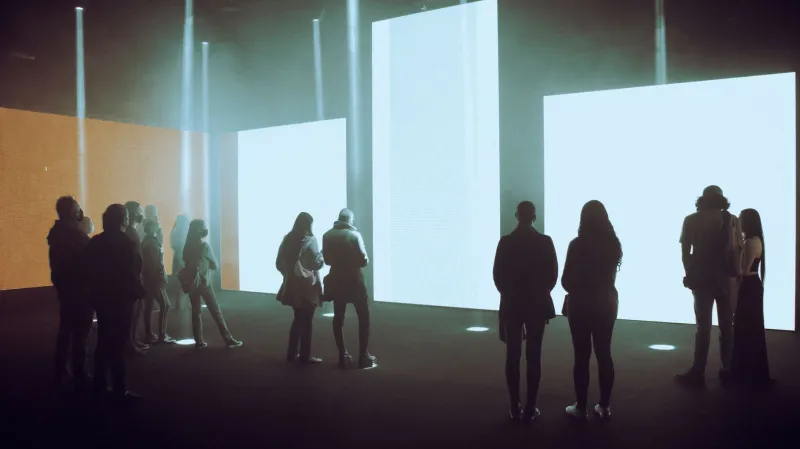
Surrounded but Unseen: The Strange Erasure of Self Inside Immersive Art
Immersive art installations promise total envelopment, yet visitors frequently report a disorienting sense of personal disappearance rather than presence. When the art surrounds you from every direction, the very act of looking outward may sever your ability to locate yourself within the experience. ArtVision 360 examines the psychological paradox at the heart of contemporary immersive culture.

The Hidden Cost of Looking Everywhere at Once: Cognitive Load and the Immersive Art Experience
Immersive art environments demand far more from the brain than a conventional gallery visit, requiring viewers to continuously decide where to look, what to prioritize, and how to synthesize overwhelming streams of simultaneous visual information. Cognitive scientists and art professionals are increasingly asking whether this mental tax enriches the encounter with art or quietly undermines it. The answer, it turns out, depends enormously on how the experience is designed — and on who is standing
Alone in the Infinite: Why Immersive Art Struggles to Fill the Space Between You and Everything Else
Immersive art environments are engineered to surround visitors with sensation from every conceivable angle, yet solitary viewers frequently report a profound and unexpected sense of disconnection. This investigation explores the psychological mechanics behind that paradox, and how artists and institutions across the United States are beginning to reckon with the role of shared human presence in making immersion feel complete.

Flattened Into Nothing: The Impossible Task of Sharing Immersive Art on Social Media
When an artwork exists in three dimensions — wrapping around a viewer's body, filling a room with layered sound, demanding physical presence — translating it into a two-inch screen thumbnail is not merely a technical inconvenience. For a growing number of contemporary artists, it may be an existential one.
Built for No One: The Quiet Crisis of Immersive Art Installations That Audiences Aren't Visiting
Across American cities, ambitious 360-degree and immersive art installations are opening their doors to near-empty rooms. Despite significant investment in both creation and promotion, attendance figures tell a sobering story — and the art world is only beginning to ask why.

Too Many Angles, Not Enough Center: The Psychological Cost of Immersive Art's Infinite Gaze
The promise of 360-degree immersive art was total engagement — a viewer finally freed from the tyranny of a single, curated perspective. Yet something unexpected is happening inside America's most technologically ambitious gallery spaces: visitors are disengaging, overwhelmed by the very abundance of visual information designed to captivate them. ArtVision 360 examines the neuroscience, the design failures, and the artistic reckoning behind immersive art's paradox of lonely infinity.
The Museum Leaves the Building: How Street Art Is Redrawing the Map of American Cultural Space
Institutional galleries across the United States are fundamentally rethinking what an exhibition space can be, driven by the undeniable cultural momentum of street and public art movements. As murals and installations claim urban walls from Los Angeles to Philadelphia, curators are confronting an uncomfortable question: has the audience already moved on? ArtVision 360 investigates the seismic shift reshaping American exhibition culture from the inside out.
Monuments to No One: The Corporate Metaverse Art Spaces That Built Everything Except an Audience
Corporations poured hundreds of millions of dollars into metaverse art experiences between 2021 and 2023, constructing elaborate virtual galleries that now sit largely empty. An investigation into these abandoned digital spaces reveals a fundamental misreading of how people actually engage with art online. As brand-backed metaverse projects quietly shutter or stagnate, a countermovement of smaller, community-driven digital art spaces is beginning to demonstrate what meaningful virtual engagement
Shattered Sight: How Contemporary Artists Are Dismantling the Tyranny of the Single Viewpoint
A growing number of contemporary artists are deliberately fracturing the viewing experience, engineering works that resist any single authoritative perspective and demand engagement from multiple angles simultaneously. This approach — manifest in split-screen video installations, architecturally site-specific sculptures, and fragmented photographic sequences — reflects a broader cultural reckoning with the fiction of objective seeing. The movement raises urgent questions about whose viewpoint ha
No Blind Spots: How Feminist Artists Are Using 360-Degree Video to Demand a New Kind of Looking
A growing movement of female and non-binary artists is turning 360-degree video technology into a radical act of self-determination, creating immersive works that refuse to let viewers choose what to see—or ignore. From community art spaces in Detroit to gallery installations in Los Angeles, these creators are dismantling the traditional power of the directorial gaze, one panoramic frame at a time.

Pixels Without Presence: The Uncomfortable Truth About Virtual Galleries and Why They Keep Falling Short
The metaverse arrived with extraordinary promises for the art world—borderless galleries, democratized access, and immersive experiences untethered from geography. Yet years into the experiment, visitor engagement remains stubbornly low and artists are quietly retreating to physical walls. What went wrong, and what would it actually take to make virtual art spaces matter?
When Sound Becomes Light: The Artists Teaching Algorithms to Paint With Music
At the frontier of generative art, a cohort of artists and creative coders is pursuing a question that has fascinated scientists and aesthetes alike for centuries: what does sound look like? By harnessing artificial intelligence, real-time audio analysis, and custom visual programming, these practitioners are translating the invisible architecture of music and ambient noise into dynamic, breathing imagery. The results are redefining what it means to experience art through more than one sense at
Scrolling Into the Gallery: How Instagram and TikTok Are Redefining Exhibition Space for a New Generation of Artists
A new generation of digital-native artists is transforming social media feeds into fully realized exhibition spaces, circumventing traditional gatekeepers and building devoted audiences one scroll at a time. From TikTok's short-form video format to Instagram's visual storytelling tools, these platforms are functioning less like promotional channels and more like curated galleries. The implications for how art is discovered, valued, and sold are profound — and the shift is already well underway.
Beyond the Frame: How America's Museums Are Engineering Total Immersion in 2024
From floor-to-ceiling projection mapping in converted warehouses to full-body virtual reality galleries housed within historic institutions, immersive art experiences are fundamentally restructuring the relationship between viewer and artwork across the United States. ArtVision 360 steps inside the most transformative exhibitions of 2024 to understand why curators, artists, and audiences alike are embracing the 360-degree turn.
Brushes Without Hands: How AI Art Tools Are Rewriting the Rules of Creative Access
Artificial intelligence platforms like DALL-E, Midjourney, and Stable Diffusion are dismantling the traditional gatekeepers of visual art, placing professional-grade creative power in the hands of anyone with an idea and an internet connection. Yet as the tools grow more sophisticated, so too does the conversation around authorship, originality, and what it truly means to make art. ArtVision 360 examines every angle of this rapidly evolving landscape.