Designed for the Initiated: How Immersive Art Installations Leave First-Time Visitors Behind
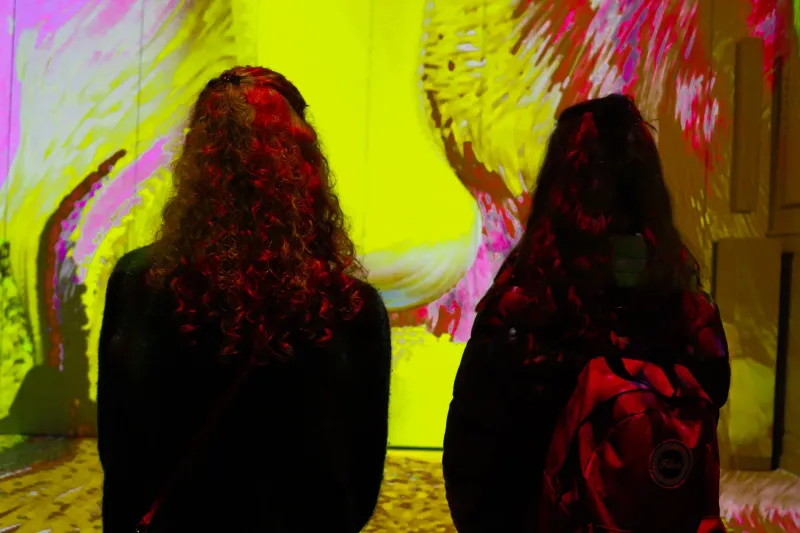
There is a particular kind of stillness that settles over a first-time visitor standing at the threshold of a large-scale immersive art installation. It is not the stillness of wonder, though that may come later. It is the stillness of not knowing where to look, where to walk, or what the experience is even asking of them. In a room where everything is the exhibit, the absence of a single focal point can be quietly paralyzing — and for a growing number of Americans encountering 360-degree art environments for the first time, that paralysis marks the beginning and, too often, the end of their engagement.
Immersive art has expanded dramatically across the United States over the past several years. From the traveling spectacles of teamLab and the Van Gogh-inspired light shows that have appeared in cities from Miami to Minneapolis, to the more conceptually rigorous installations occupying museum wings and converted industrial spaces, the format has attracted enormous public interest. Ticket sales have surged. Social media coverage has amplified visibility. And yet, for all this cultural momentum, a fundamental question of design remains largely unaddressed: who, exactly, are these spaces built for?
The Problem With Having No Beginning
Conventional exhibition spaces operate on an implicit grammar that most visitors absorb without realizing it. Artwork hangs on walls. Labels appear beside pieces. A natural path — whether marked or intuited — guides the visitor from one work to the next. The structure may be simple, but it performs an essential function: it tells you where you are in relation to the art, and it tells you what to do next.
Immersive installations deliberately dismantle this grammar. The floor, ceiling, and walls may all carry projected imagery. Sound arrives from multiple directions simultaneously. Movement through the space is often unscripted, even encouraged to be non-linear. For visitors already fluent in the language of contemporary art, this freedom can feel liberating. For those without that fluency, it frequently registers as abandonment.
Artists working in omnidirectional formats often speak of wanting to dissolve the boundary between viewer and work — to create an environment rather than an object. This is a legitimate and historically grounded artistic ambition. The challenge is that dissolving boundaries also dissolves the navigational cues that less experienced visitors rely upon. When there is no frame, no wall label, no obvious starting point, the visitor is left to construct their own interpretive framework on the spot. Many are simply not equipped to do so, and no amount of enthusiasm for art compensates for a lack of experiential vocabulary.
What the Signage Doesn't Say
Visitor orientation in immersive spaces tends to follow one of two inadequate models. The first is near-total silence: no instructions, no suggested duration, no guidance whatsoever, on the theory that the work should speak for itself. The second is a brief introductory panel placed at the entrance — a paragraph or two of artist statement that describes the conceptual intent of the piece without offering any practical guidance on how to inhabit it.
Neither approach serves the first-time visitor particularly well. Artist statements, however eloquently written, address the meaning of an experience rather than the mechanics of having one. Telling a visitor that an installation "explores the fluid boundaries between digital and organic perception" does not tell them whether they should stand still or keep moving, how long they might expect to spend inside, whether the experience changes depending on where they position themselves, or what they might productively pay attention to.
Some institutions have begun experimenting with more substantive orientation strategies — short introductory videos, trained floor staff positioned inside the installation itself, or audio guides that offer gentle prompts without over-determining the experience. These efforts are promising, but they remain the exception rather than the rule. The dominant curatorial attitude still leans toward withholding guidance as a form of respect for the work's openness, a posture that inadvertently conflates accessibility with artistic compromise.
Spatial Design as an Unspoken Argument
Beyond signage and curatorial framing, the physical architecture of immersive spaces frequently encodes assumptions about visitor competence. Installations designed with a single point of entry but no suggested path through the space assume that visitors will naturally distribute themselves and discover the work organically. In practice, many first-time visitors cluster near the entrance, uncertain whether it is permissible to walk further in, unsure whether the experience has already begun or whether they are still in a transitional zone.
The scale of many installations compounds this disorientation. A room that spans several thousand square feet and wraps the visitor in continuous projected imagery offers no natural resting point for the eye, no compositional anchor. Experienced contemporary art audiences have developed strategies for navigating this kind of visual density — they slow down, they move deliberately, they allow themselves to be disoriented as part of the experience. Casual visitors, by contrast, often speed up, moving through the space more quickly than the work rewards, because movement feels more purposeful than standing still in a state of confusion.
This is not a failure of imagination on the part of visitors. It is a failure of design. The spatial logic of a 360-degree environment need not be identical to that of a conventional gallery, but it does need to exist — and it needs to be communicated in terms that do not presuppose a graduate seminar's worth of art historical context.
Rethinking Who the Audience Actually Is
The commercial success of immersive art in the United States has been driven, in large part, by audiences who would not typically describe themselves as regular museum-goers. The blockbuster Van Gogh and Monet light experiences drew millions of visitors who were drawn by the spectacle, by the social media imagery, by the novelty of the format rather than by any prior investment in contemporary art discourse. This is not a demographic to be condescended to. It is an opportunity.
If immersive art formats are genuinely capable of reaching audiences that conventional gallery culture has failed to engage, then the design of these experiences carries a responsibility that extends beyond satisfying the expectations of the already-converted. Making a 360-degree installation accessible to a first-time visitor does not require dumbing it down. It requires thinking carefully about the difference between intentional disorientation — which can be a powerful artistic tool — and unintentional confusion, which is simply a design problem.
Some artists and institutions are beginning to take this distinction seriously. Curatorial teams at several major American museums have started conducting structured visitor observation studies inside immersive installations, tracking where people stop, where they accelerate, and where they leave. The findings are being used to inform spatial layout and orientation materials in ways that preserve the experiential integrity of the work while reducing unnecessary barriers to entry.
This kind of iterative, audience-responsive thinking represents the more honest expression of what immersive art has always claimed to be: an experience designed to include, rather than to impress. The 360-degree format promises that there is no wrong place to look. The least its practitioners can do is ensure that visitors believe them.