Consumed by the Work: When Immersive Art Installations Swallow the Artist Whole
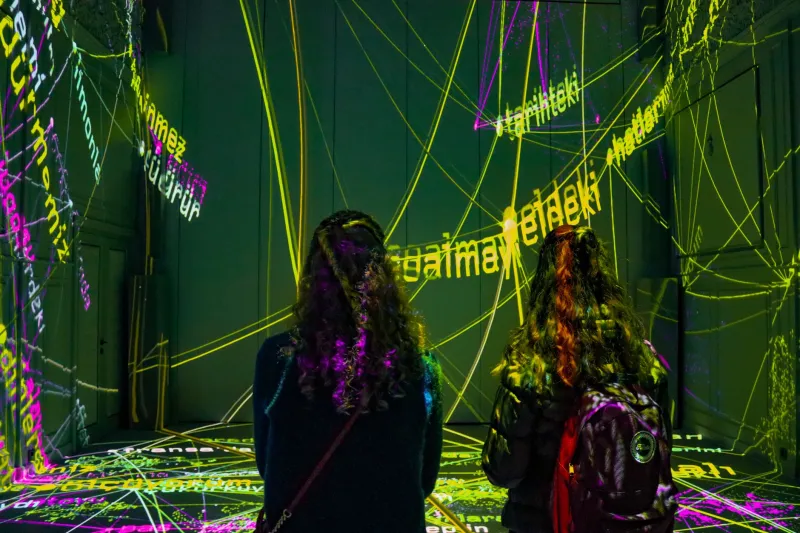
There is a particular kind of disorientation that arrives not from the work itself, but from the realization, somewhere in the middle of it, that you have no idea whose work it is. You are standing inside a cavernous room, surrounded on every surface by shifting light, ambient sound, and projected imagery that moves in response to your body. It is extraordinary. It is also, in a meaningful sense, anonymous.
This is the quiet paradox at the heart of contemporary immersive art: the more completely an installation surrounds its audience, the more thoroughly it tends to obscure the human intelligence behind it. Across the United States, from the converted warehouses of Brooklyn to the purpose-built experiential venues of Los Angeles, a generation of artists is wrestling with a format that may be structurally resistant to the concept of authorship itself.
The Architecture of Anonymity
Traditional exhibition culture has always offered clear lines of attribution. A painting on a wall carries a label. A sculpture on a plinth bears a title card. Even in large-scale public installations, the artist's name is typically foregrounded — on press materials, on signage, in the cultural conversation surrounding the work. The viewer may not engage deeply with that information, but it is present, available, anchoring the experience to a specific human intention.
Immersive installations operate differently. Their architectural ambition — the desire to occupy every angle of a viewer's perceptual field — tends to push informational content to the margins. Signage feels intrusive in a room designed to be total. Artist statements, when they exist, are often tucked into a lobby pamphlet that most visitors never read. The work itself, by design, discourages the kind of reflective pause that might prompt a viewer to ask: who made this, and why?
The result is a format that prioritizes sensation over attribution, and experience over context. For many visitors, that is precisely the appeal. But for the artists involved, it represents a genuine professional and philosophical tension.
Artists Speaking From the Margins of Their Own Work
Several contemporary artists working in the immersive space have described a version of the same experience: the moment when they attend an opening of their own installation and watch visitors move through it without any apparent awareness that a specific person conceived and built what surrounds them.
One Brooklyn-based artist who works primarily in large-scale projection and spatial sound described the feeling as "professionally productive but personally strange." Her installations have appeared in major venues across the Northeast, and she has noted that audience members frequently attribute her work to the venue itself, or to a generic category of "digital art" that implies collective or technological rather than individual authorship. "People ask the venue staff who made it," she observed in a recent panel discussion. "Sometimes the staff doesn't know either."
This is not a marginal concern. It touches directly on questions of artistic legacy, on the commercial structures that support working artists, and on the broader cultural function of art as a form of human communication between a specific maker and a specific audience.
The Technological Displacement of the Human Hand
Part of what makes authorial invisibility so persistent in immersive art is the role of technology as an apparent intermediary. When a viewer encounters a room filled with algorithmically responsive projections, the instinct is often to credit the software, the hardware, or the technical team rather than the conceptual artist who determined what the system should do and why.
This is a misunderstanding of how most immersive art is made, but it is a misunderstanding the format actively encourages. The visible apparatus of immersive installation — the projectors, the sensors, the servers, the cables — foregrounds process over vision. It implies that the work emerged from a technical procedure rather than from a sustained artistic intelligence.
Some artists have responded by deliberately reintroducing traces of their own hand into otherwise digital environments: hand-drawn source imagery, spoken-word audio in their own voice, visible brushwork in the projected source material. These gestures function as signatures, small insistences of human presence within a medium that tends toward the impersonal. Whether they succeed in restoring a sense of authorship — or simply become absorbed into the larger environmental effect — is a question each installation answers differently.
Does Immersion Require Erasure?
There is a more radical position, held by a smaller but vocal contingent of artists and critics, that the erasure of authorship is not a problem to be solved but a condition to be embraced. On this view, the immersive format achieves something that conventional gallery art cannot: it removes the artist from the transaction between work and viewer, allowing the audience to inhabit the piece without the mediating presence of a named creator.
This argument has genuine philosophical weight. It draws on a long tradition of thinking about the relationship between artistic intention and audience experience, from Roland Barthes's formulation of the death of the author to the participatory art movements of the late twentieth century. If the goal of an immersive installation is to create an experience that belongs fully to the person inside it, then the artist's visibility may be not just unnecessary but actively counterproductive.
But this position tends to serve institutions and commercial venues better than it serves artists. The venues that host immersive experiences benefit enormously from the format's appeal — ticket sales, social media visibility, corporate event bookings — while the artists whose labor and vision made those experiences possible are systematically rendered invisible to the audiences generating that value. The philosophical argument for authorial erasure can function, in practice, as a convenient justification for a structural inequity.
Toward a More Legible Immersion
The challenge for the field is to develop exhibition practices that honor both the experiential ambitions of immersive art and the legitimate claim of artists to be known by their audiences. This is not simply a matter of better signage, though better signage would be a start. It requires a more fundamental rethinking of how immersive venues introduce and contextualize the work they present.
Some institutions are experimenting with audio guides that speak in the artist's own voice, offering personal context without interrupting the experiential flow of the installation. Others are building pre-entry orientation spaces where visitors encounter the artist's process and intention before stepping into the work itself. These approaches acknowledge that immersion and attribution are not mutually exclusive — that a viewer can be fully surrounded by an artist's vision and still know whose vision it is.
The question is whether the commercial pressures driving the immersive art market will allow space for that kind of contextual care. In an environment where venues compete primarily on spectacle, the artist's individual identity can seem like an inconvenient complication — a detail that slows the visitor's passage from entrance to experience.
For the artists themselves, the stakes are considerably higher. To make work that surrounds and moves thousands of people, and to remain invisible to every one of them, is a particular kind of professional solitude. The immersive format offers extraordinary reach. What it has not yet learned to offer, in most cases, is recognition.