Mirror in the Museum: How the Urge to Document Yourself Inside Immersive Art Quietly Dismantles the Experience
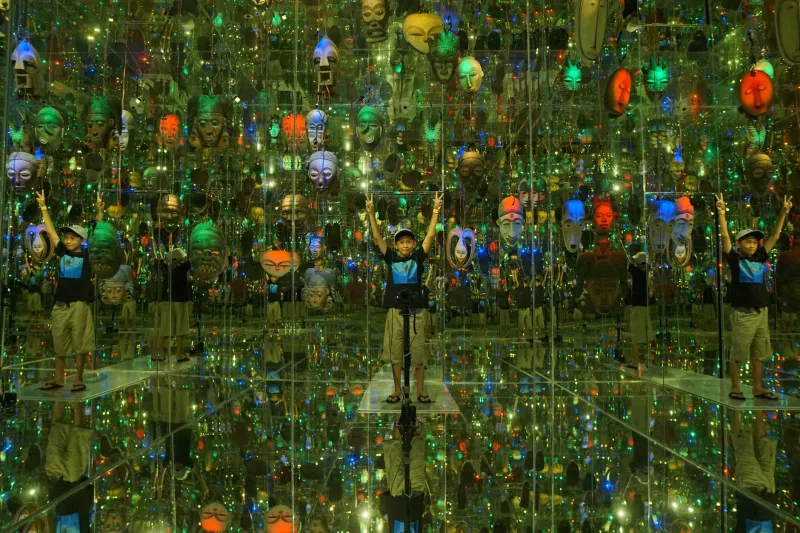
There is a particular moment that has become almost ceremonial inside America's most celebrated immersive art installations. A visitor steps into a room — perhaps one flooded with projected light, perhaps one lined with infinite mirrors, perhaps one where the floor itself seems to dissolve — pauses for less than three seconds, and then raises a phone. What follows is not contemplation. It is choreography.
The selfie, in this context, is not merely a photograph. It is a declaration of presence. And therein lies the central paradox that artists, curators, and cognitive scientists are increasingly grappling with: the very act of asserting that you are in an immersive experience may be the surest way to ensure that you never truly enter it.
The Attention Economy Walks Into the Gallery
Immersive art installations — from Yayoi Kusama's Infinity Mirror Rooms to the large-scale projection environments produced by studios like teamLab and Meow Wolf — are designed around a specific psychological premise. They aim to induce what researchers call absorbed attention, a state in which the boundaries between self and environment begin to soften. The goal, at its most ambitious, is something approaching aesthetic transcendence: the visitor ceases to be an observer and becomes, temporarily, part of the work itself.
But absorbed attention is fragile. It requires the suspension of self-monitoring — the internal narrator that tracks how we appear to others, how we are performing our own experience. And nothing activates self-monitoring more efficiently than a camera pointed at your own face.
Psychologists refer to this as self-objectification: the process by which a person shifts from experiencing themselves as a subject to evaluating themselves as an object to be seen. Studies conducted in contexts ranging from social media use to exercise behavior consistently show that self-objectification interrupts flow states and diminishes the quality of direct experience. When applied to the gallery setting, the implications are pointed. The visitor who documents themselves inside an immersive installation is, in a measurable sense, no longer fully inside it.
What Artists Are Noticing
Curators and installation artists working in the United States have begun to speak more openly about the behavioral patterns they observe in audiences navigating participatory spaces. The observations are consistent, if quietly unsettling.
Visitors frequently move through immersive environments in search of optimal camera angles rather than optimal experiential positions. They gravitate toward the spots where the light is most flattering, where the background reads most dramatically in a vertical frame. They position themselves, adjust, photograph, review, and reposition — a loop that bears more resemblance to a commercial photo shoot than to the open-ended wandering these environments were designed to encourage.
Some artists have responded by designing installations that actively resist easy documentation. Certain rooms are engineered to be disorienting on camera — the visual coherence that makes them so affecting in person collapses into noise on a phone screen. Others have introduced deliberate obstacles: narrow corridors, timed lighting sequences, surfaces that generate glare under artificial flash. The intent is not punitive but restorative — an attempt to redirect the visitor's attention back toward the body and away from the screen.
The Cognitive Dissonance of Being Both Viewer and Subject
What makes this phenomenon particularly interesting from a psychological standpoint is that most visitors are not consciously choosing documentation over experience. They believe, sincerely, that they are doing both simultaneously. This belief is the core of the dissonance.
Cognitive science offers little support for that optimism. Attention is not infinitely divisible. The mental resources required to compose a photograph — framing, timing, self-presentation, anticipation of audience response — are drawn from the same pool that would otherwise fund aesthetic absorption. The visitor is not half-present in two experiences; they are partially present in neither.
There is also a temporal dimension worth considering. The impulse to photograph an experience is partly driven by the desire to possess it, to extend it beyond its actual duration. But research on what psychologists call the photo-taking impairment effect suggests that photographing an object or environment actually reduces the detail with which it is later remembered. The image substitutes for the memory rather than supplementing it. The visitor who photographs their way through an installation may leave with a rich archive and a surprisingly thin recollection of how the space actually felt.
Participation Versus Presence
The rise of participatory art — installations explicitly designed to incorporate the visitor's body as a formal element — complicates this picture further. In these environments, being in the work is not incidental; it is the point. The visitor is not a passive observer but an active constituent of the piece. Documentation, in this framing, might even seem appropriate: if you are part of the artwork, photographing yourself is photographing the artwork.
But participation and presence are not the same thing. Participation is physical; presence is attentional. A visitor can move through a participatory installation — triggering sensors, altering projections, completing the circuit of the work — while remaining psychologically at a remove, managing their appearance and curating their digital output. The body is in the room. The mind is elsewhere.
Artists working in this space are increasingly aware of the distinction. Some have begun incorporating explicit invitations to stillness — moments within an installation where the environment rewards sustained attention in ways that a quick pass-through cannot access. Others have introduced what might be called anti-climax design: the most visually striking elements of a space are encountered only after a period of quiet navigation, creating a structural incentive to slow down.
What Institutions Can Do
American museums and cultural institutions face a genuine tension here. Visitor-generated social media content has become a primary driver of exhibition awareness and ticket sales. The selfie inside the Kusama room is, from a marketing perspective, an asset. Discouraging it carries real costs.
Yet a growing number of institutions are experimenting with designated documentation zones — specific areas within an installation where photography is not only permitted but encouraged, with the implicit understanding that other areas are reserved for unmediated experience. The approach is imperfect, and compliance is uneven. But it represents an acknowledgment that the institution has a role to play in shaping not just what visitors see, but how they see it.
Some venues have gone further, offering phone-free sessions — timed entry windows during which photography is suspended entirely. Anecdotal reports from institutions that have piloted these sessions suggest that visitor behavior shifts noticeably: people linger longer, speak more quietly, and report higher levels of satisfaction in post-visit surveys.
The Angle We Keep Missing
Immersive art, at its most ambitious, offers something genuinely rare in contemporary American cultural life: an invitation to be nowhere but here. No feed to scroll, no notification to manage, no performance to sustain. Just a body in a room that has been designed, with considerable care, to make that body feel something.
The irony is that the spaces most capable of delivering that experience have also become the spaces most aggressively colonized by the documentation impulse. The 360-degree perspective that defines immersive art — the sense of being surrounded, held, addressed from every direction — is precisely what makes these environments so photogenic, and so vulnerable to the attentional fragmentation that photography introduces.
The question is not whether visitors should be permitted to photograph themselves inside immersive installations. That debate has largely been settled by market forces. The more productive question is what we lose when we consistently choose the image over the encounter — and whether, having identified that loss, we are willing to occasionally set the phone down and simply look.