Small Room, Infinite Mind: The Neuroscience Behind Why Immersive Art Fools Us Into Feeling Boundless
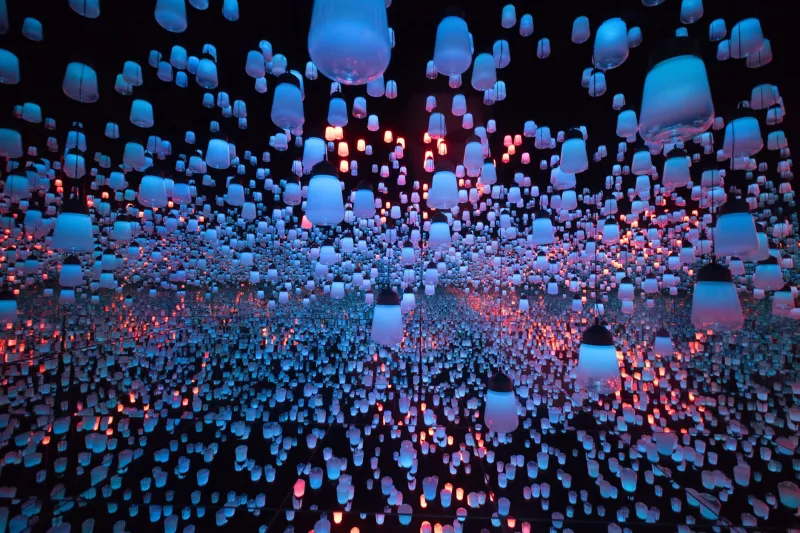
There is a particular moment that visitors to large-scale immersive installations almost universally describe. It arrives not at the entrance, but a few seconds after — once the eyes have adjusted and the brain has attempted, and failed, to locate a boundary. The room, which may measure no more than forty feet across, suddenly feels like it has no walls at all. The floor seems to dissolve. The ceiling retreats. A space that a fire marshal has certified for a specific occupancy count becomes, in the visitor's perception, something approaching the infinite.
This is not magic. It is neuroscience, and artists working in immersive and 360-degree formats have been exploiting it with increasing sophistication for decades.
The Brain's Reluctant Cartographer
Human spatial perception is, at its core, a prediction engine. The brain does not passively receive information about a room and render it faithfully. Instead, it constructs a working model from incomplete data — the angle of light, the convergence of lines, the relative size of familiar objects — and fills in the rest with educated inference. When an artist systematically removes the cues the brain relies on to triangulate scale and boundary, the prediction engine stalls.
Dr. Sarah Kessler, a cognitive neuroscientist at the University of California, San Diego who studies spatial cognition in artistic environments, describes the phenomenon as a kind of sensory negotiation failure. "The brain is constantly asking, 'Where are the edges?' When an installation is designed to suppress every reliable answer to that question — through mirrored surfaces, projected light that eliminates shadow, or imagery that recedes in all directions — the brain doesn't simply give up. It defaults to expansiveness. It assumes the space is larger than it can confirm, because that is the safer perceptual error from an evolutionary standpoint."
In other words, our ancestors were better served by overestimating the size of an open savanna than by underestimating it. Immersive artists have, perhaps inadvertently, found a way to trigger that ancient bias inside a converted warehouse in Brooklyn or a museum annex in Los Angeles.
Mirrors, Layers, and the Architecture of Deception
The technical toolkit available to installation artists pursuing this effect is surprisingly varied. Mirrored surfaces remain among the most powerful instruments, as demonstrated by artists such as Yayoi Kusama, whose Infinity Mirror Rooms have drawn record-breaking attendance at institutions across the United States. The reflective recursion those works generate does not merely double the perceived space — it creates a visual regression that the eye follows until the reflected image falls below the threshold of resolution. The room, in that moment, appears to extend forever.
But mirrors are only one strategy. Projected imagery that wraps continuously across floor, walls, and ceiling eliminates the architectural seams that normally orient a visitor. When every surface is active and every surface connects seamlessly to every other, the room's actual geometry becomes irrelevant to perception. The brain abandons the task of measuring it.
Layering is another mechanism that installation artists deploy with considerable precision. By placing semi-transparent scrims at varying depths within a space and projecting different imagery onto each, artists create a parallax effect — the same principle that makes objects at different distances appear to move at different rates when viewed from a moving vantage point. The result is a convincing sense of depth that extends well beyond the physical distance between the viewer and the far wall.
Chicago-based installation artist Marcus Delray, whose work has been exhibited at the Museum of Contemporary Art Chicago and the Pérez Art Museum Miami, has built an entire practice around this layered approach. "I think of the space I'm given as almost irrelevant to the space I'm building," he explains. "Twenty feet of physical depth can become, perceptually, a quarter mile. You're not lying to the audience. You're giving their brain permission to experience something it already knows how to experience — open space — in a context where open space shouldn't exist."
When Disorientation Becomes the Point
Not all artists pursuing this spatial confusion regard it as a purely pleasurable gift to their audiences. Some are explicitly interested in the unease that accompanies the collapse of spatial certainty. When a visitor cannot locate the edges of a room, they also cannot locate themselves within it with any precision. The sense of groundlessness that follows can range from exhilarating to genuinely unsettling.
This is terrain that has attracted significant curatorial attention in recent years. Exhibitions at institutions including the Smithsonian's Hirshhorn Museum in Washington, D.C., and the Broad in Los Angeles have increasingly contextualized immersive works not simply as spectacle, but as investigations of perception, identity, and the constructed nature of our experience of space. The interpretive framing matters: visitors who understand that their disorientation is intentional and meaningful tend to engage with it differently than those who experience it without context.
Dr. Kessler notes that the neurological response to spatial disorientation in an art context activates some of the same regions as genuine threat perception. "There's a low-level stress response. The amygdala is involved. But the prefrontal cortex, because the person understands they are in a gallery and not in actual danger, modulates that response into something that reads as excitement or wonder rather than fear. The physiological signature is similar; the interpretation is entirely different."
The Ethics of Manufactured Infinity
As immersive installations become more technologically sophisticated and more commercially prevalent — the touring exhibition market in the United States has expanded dramatically since 2019, with large-scale immersive experiences now appearing in cities from Seattle to Miami — questions about the ethics of perceptual manipulation deserve more sustained attention than they typically receive.
When an artist or, increasingly, a production company designs an environment specifically to override a visitor's spatial reasoning, what obligations accompany that power? The question is not hypothetical. Reports of visitors experiencing vertigo, anxiety, and disorientation-related falls in immersive environments have surfaced at several high-profile exhibitions. The same perceptual mechanisms that generate wonder can, in susceptible individuals, generate genuine distress.
Delray acknowledges the weight of this. "I think about it constantly. The tools I'm using are not neutral. They're reaching into someone's nervous system and doing something to it. That's a responsibility."
For now, the field is navigating these questions largely through practice rather than policy. Some institutions have introduced designated low-stimulation viewing periods for visitors with sensory sensitivities. Others have added detailed pre-visit descriptions of the perceptual effects their exhibitions produce.
What the Edges Reveal
Perhaps the most revealing aspect of the immersive art experience is what happens when the spell breaks — when a visitor glimpses a projector cable, notices the seam where two mirrored panels meet, or simply moves close enough to a wall to confirm that it is, in fact, a wall. The room contracts. The infinite retreats. What remains is a modestly sized space and the memory of something much larger.
That memory, neuroscientists suggest, may be as real as any other. The brain that experienced boundlessness for ten minutes inside a forty-foot room has not been deceived in any meaningful sense. It has been given an experience it could not have accessed any other way. Whether that constitutes art's highest function, or merely its most impressive trick, is a question that 360-degree immersive culture is only beginning to force us to ask.